GermanyAufgabe 127 · Politics in a democracy
Why is there a 5% threshold in the electoral law of the Federal Republic of Germany? It exists because …
In the exam (German)
Warum gibt es die 5%-Hürde im Wahlgesetz der Bundesrepublik Deutschland? Es gibt sie, weil …
- athe programmes of many small parties have a lot in common.die Programme von vielen kleinen Parteien viele Gemeinsamkeiten haben.
- bcitizens can lose their way when there are many small parties.die Bürgerinnen und Bürger bei vielen kleinen Parteien die Orientierung verlieren können.
- cmany small parties make it harder to form a government.viele kleine Parteien die Regierungsbildung erschweren.Correct answer
- dsmall parties do not have enough money to pay the politicians.die kleinen Parteien nicht so viel Geld haben, um die Politikerinnen und Politiker zu bezahlen.
Why?
Many small parties in parliament make it hard to form a stable majority and therefore a government. This is a lesson from the Weimar Republic: at that time, very many parties sat in the Reichstag, and governments changed often. The 5% threshold is meant to prevent this.
Translated with AI. In the exam the question is in German, as shown above.
Check yourself
Would you know these too?
The same number of questions and the same pass mark as the real test, marked at once. Your first mock is free and needs no account.
Take a free mock examAufgabe 128
Members of parliament who are elected by the citizens are called …Correct answer:representatives (Abgeordnete).
Parlamentsmitglieder, die von den Bürgerinnen und Bürgern gewählt werden, nennt man … — Abgeordnete.
Aufgabe 129
In Germany, the people elect …Correct answer:the Bundestag.
Vom Volk gewählt wird in Deutschland … — der Bundestag.
Aufgabe 130
Which ballot paper would be valid in an election to the Bundestag (Bundestagswahl)? Based on the Federal Electoral Regulations (Bundeswahlordnung, BWO), Annex 26Correct answer:1
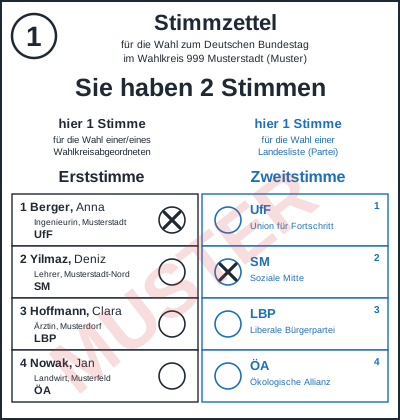
Welcher Stimmzettel wäre bei einer Bundestagswahl gültig? In Anlehnung an Bundeswahlordnung (BWO), Anlage 26 — 1
Aufgabe 131
In Germany, a mayor (Bürgermeisterin/Bürgermeister) is …Correct answer:the head of a municipality.
In Deutschland ist eine Bürgermeisterin/ein Bürgermeister … — das Oberhaupt einer Gemeinde.
Source
Questions and options: Federal Office for Migration and Refugees (BAMF), Gesamtfragenkatalog for the “Leben in Deutschland” test and the Einbürgerungstest, as of 07.05.2025 (Annex 1 to the Einbürgerungstestverordnung). The English translation and the explanations are ours, written with AI; in the exam the questions are asked in German. The coats of arms, flags and photos come from Wikimedia Commons, the maps and ballot papers are drawn by us – authors and licences are listed under Image credits. This is not a government service.
Official informationTry it under exam conditions.
The same number of questions and the same pass mark as the real test, marked at once. Your first mock is free and needs no account.
The pass €7.99 · 180 days of access for one payment — it never renews